The United States on Sunday condemned China’s coast guard and navy for using dangerous blocking maneuvers to disrupt a Philippine resupply mission in the South China Sea, backing Manila’s account of the incident two days after Beijing had disputed it.
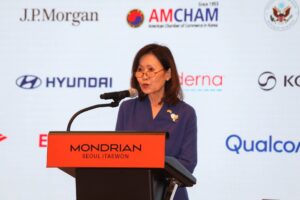
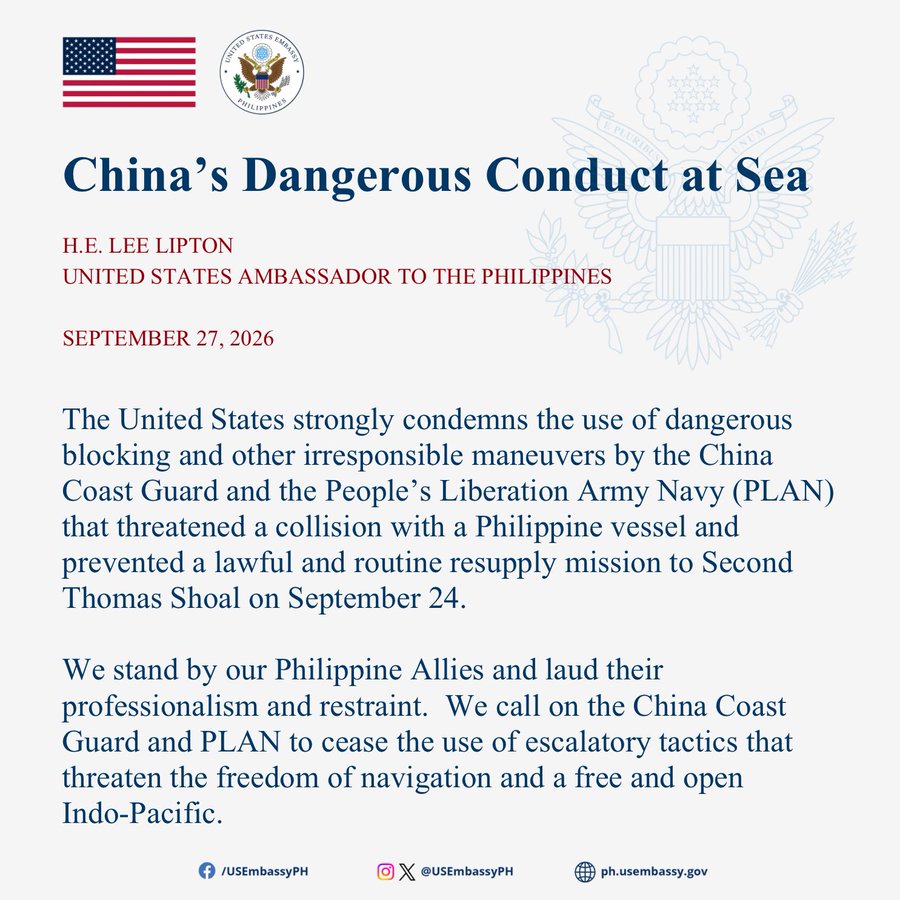
U.S. Ambassador to the Philippines MaryKay Carlson — referred to in the source material as “Lipton” — said in a statement posted to X that Chinese coast guard and People’s Liberation Army Navy vessels engaged in “dangerous blocking maneuvers and other irresponsible actions” on Sept. 24 that threatened to collide with Philippine ships and prevented the completion of a “lawful and routine” resupply mission to Second Thomas Shoal.
“The United States strongly condemns the People’s Republic of China Coast Guard and PLA Navy’s use of dangerous blocking and other irresponsible maneuvers to threaten collision with Philippine vessels and obstruct a lawful and routine resupply mission to Second Thomas Shoal on September 24,” the ambassador said. “The United States stands with our Philippine allies and commends their professionalism and restraint. The PRC Coast Guard and PLA Navy must cease their escalatory tactics that threaten freedom of navigation and a free and open Indo-Pacific.”
According to Reuters, the Philippine Coast Guard first disclosed the incident Sept. 25, saying Chinese vessels had obstructed the operation and created serious risk of collision. Philippine Coast Guard spokesperson and South China Sea task force commodore Jay Tarriela said no collision or injuries occurred but that Chinese maneuvers created a serious risk of one. The mission was not completed.
China disputed the Philippine account the same day. Chinese coast guard spokesperson Zhang Le said Manila had ignored Beijing’s warnings by sending a supply vessel to the grounded warship, prompting Chinese forces to conduct “on-site monitoring” and issue verbal warnings — characterizing the response as legitimate surveillance rather than dangerous blocking.
Citing the Philippine National Task Force for the West Philippine Sea, USNI News reported that coast guard patrol ships BRP Malabrigo and BRP Cabra were escorting the Navy-operated supply boat Lapu-Lapu when Chinese forces intervened. Three Chinese vessels shadowed the convoy from roughly 60 nautical miles from Second Thomas Shoal, while 11 Chinese coast guard and maritime militia ships were spotted near the shoal and nearby Sabina Shoal, around the grounded World War II-era landing ship BRP Sierra Madre.
The mission aimed to deliver supplies and rotate personnel stationed aboard the Sierra Madre, which the Philippines deliberately grounded on the shoal in 1999 and uses as a military outpost to assert its claim in the disputed waters.
Notably, the U.S. statement came after Washington had already seen China’s rebuttal, and it largely adopted the language Manila had used — “dangerous maneuvers” and “threat of collision” — explicitly siding with the Philippines over China’s account.
Second Thomas Shoal, known in the Philippines as Ayungin Shoal, is one of several South China Sea features contested by Beijing and Manila. The Philippines has said China’s actions violate international law and a 2016 international arbitration ruling that invalidated Beijing’s broad claims to the South China Sea, and has vowed to continue lawful operations and assert its sovereign rights in the area.
The Philippines and China reached a provisional arrangement in 2024 governing resupply missions to Second Thomas Shoal, which Manila’s foreign ministry has credited with preventing confrontations. In July, Manila accused China’s coast guard of firing water cannons at government vessels near Scarborough Shoal and striking Philippine naval personnel with poles in a separate encounter near Second Thomas Shoal.
The incident comes shortly after a summit between Chinese President Xi Jinping and U.S. President Donald Trump, in which the two sides agreed to extend a trade truce but reached no breakthrough on broader disputes, including the South China Sea, Taiwan and technology. Analysts say the U.S. statement signals that while Washington will continue diplomatic and economic engagement with Beijing, it does not intend to soften its position on its mutual defense treaty with the Philippines or freedom of navigation in the Indo-Pacific. The ambassador did not indicate any additional U.S. military response.