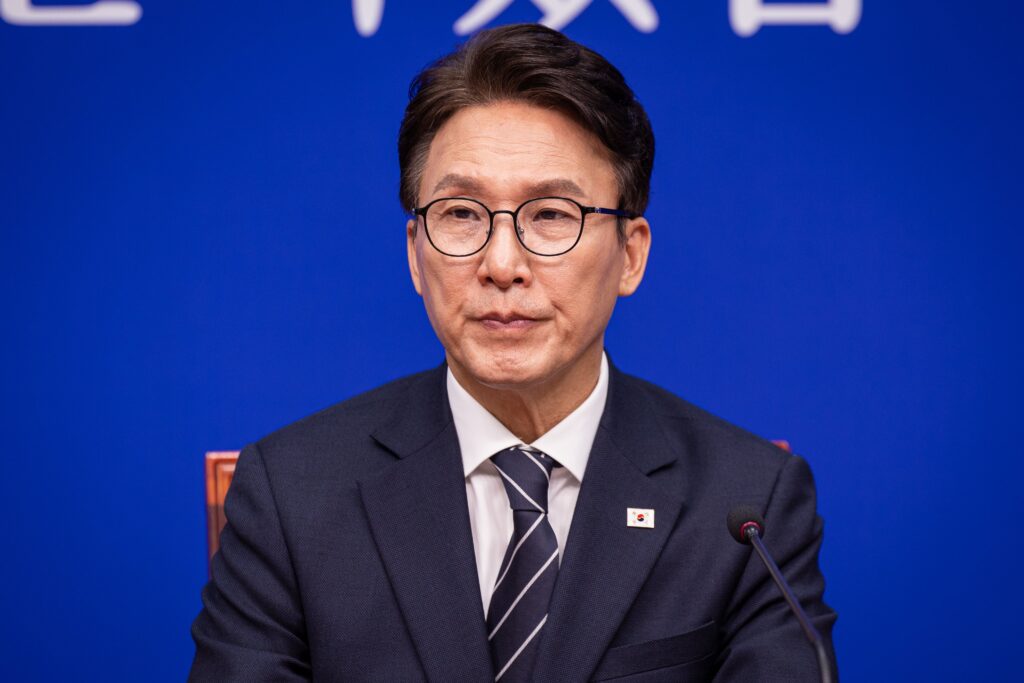
South Korea’s ruling Democratic Party sent mixed signals Monday, as party leader Kim Min-seok pressed an attack on the judiciary while a senior lawmaker publicly urged colleagues to stop feuding.
Speaking at the party’s 18th Supreme Council meeting at the National Assembly, Democratic Party leader Kim Min-seok criticized Chief Justice Cho Hee-dae over his rejection of a Supreme Court justice renomination, saying the party had heard widespread public “aversion to the unusual” during the Chuseok holiday. Kim said the chief justice had discussed unrelated matters during tea with the president, then abruptly announced the rejection the next day just as the president was boarding a plane.
Kim also referenced the Supreme Court’s conduct on the night of the Dec. 3 martial law declaration, allegations over the court’s use of operating expenses, and claims that a nominee had received a phone call pressuring him to withdraw. Kim said correcting what he called constitutional and legal violations by the judiciary was fundamental to South Korea’s democracy.
On other matters, Kim offered condolences to a commander, troops and their families injured in a recent explosion at the Demilitarized Zone on the western front, saying he had postponed a hospital visit out of consideration for shaken relatives. He called for a transparent, thorough investigation free of political calculation. He also pointed to signs of renewed U.S.-North Korea dialogue and the debate over acquiring nuclear-powered submarines, saying support was growing for both a strong defense posture and a sustainable inter-Korean peace framework, and pledged continued dialogue with opposition parties on livelihood issues.
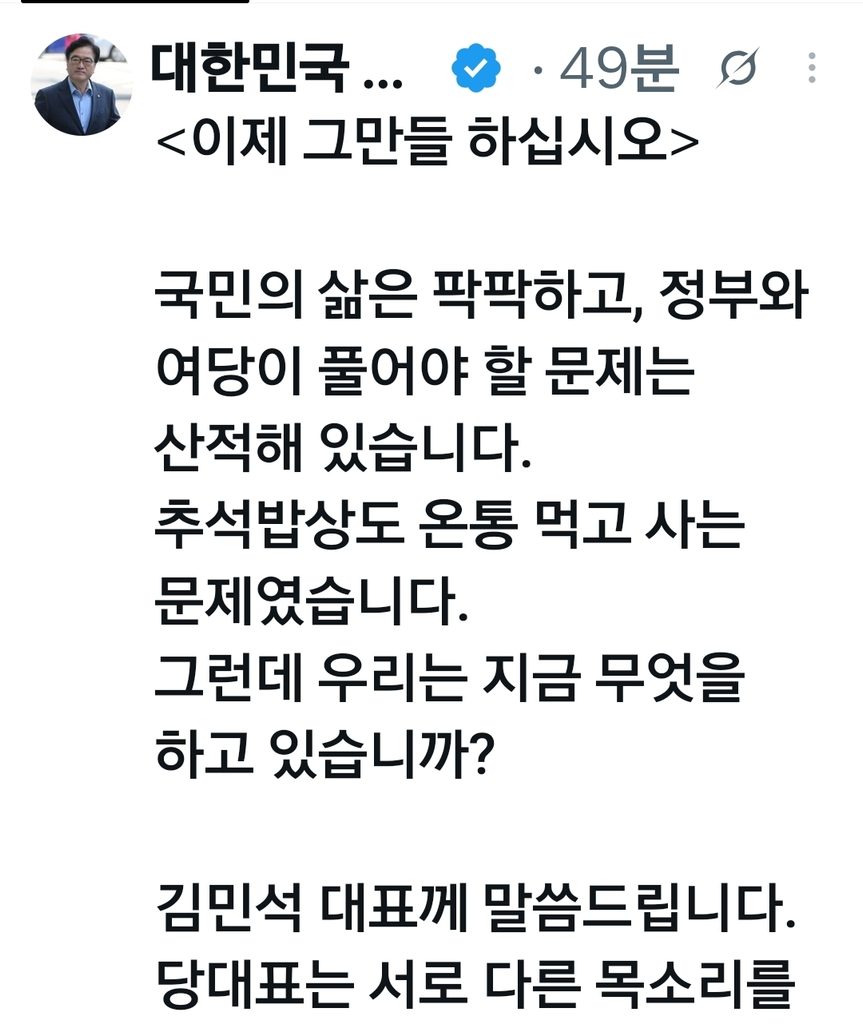
Separately Monday, Rep. Woo Won-shik, a former National Assembly speaker, posted a message on X titled “Enough now,” directly criticizing continued infighting within the party. Woo said the public was struggling economically and that even holiday dinner conversations centered on livelihood concerns, while the party continued to trade barbs.
Woo said a party leader’s role was to reconcile differing views and unite the party, not deepen division, and asked what the party intended to show the public. He also referenced writer Yoo Si-min, saying his point had “already been sufficiently made” and that it was time to consider the impact of his remarks.
Woo further urged senior party figures, including South Chungcheong Governor Chu Mi-ae and Rep. Song Young-gil, to act with greater responsibility as party leaders. On relations with the Rebuilding Korea Party, he questioned why the allies were sharpening rhetoric against each other while discussing a broader progressive coalition.
“The public is worried right now about prices, housing costs, jobs and retirement,” Woo wrote. “With so much work to be done, is it right for the pro-government camp to be fighting over pride?” He closed by saying politics should be about changing people’s lives, not winning arguments — and that voters need policies, not a victor in a war of words.